
I Accidentally Invented a Search Term
I published my first post on March 20th — a rabbit hole think-piece about XNU, WASM, and why Apple’s Universal Binary is two binaries in a trench coat. I hit publish, shared it, refreshed analytics compulsively for twenty minutes, and continued with my day.
A week later: 800 LinkedIn impressions, 92 views on dev.to. I… did not expect that.
Okay but what does that actually mean
LinkedIn impressions are famously decoupled from reality, so I checked dev.to’s traffic breakdown. LinkedIn Android: 40 views. Bluesky: 4. dev.to discovery: 2. And then: google.com: 10.
Ten views from Google. Eight days old. Worth investigating. So I searched “universal microkernel.”
Wikipedia. A Reddit thread from r/osdev. And then, third result: me.
Huh.
“Universal microkernel” is not an established term. There’s microkernel theory — decades old. There’s Apple’s Universal Binary. There’s WASM-based sandboxing research. But “universal microkernel” as a coherent named concept? I assembled that while thinking out loud. It’s not in any paper. It didn’t exist before March 20th.
Then I checked Brave Search. (Yes, I use Brave Search. Yes, it has an AI summary. No, I’m not explaining my browser habits to you.)
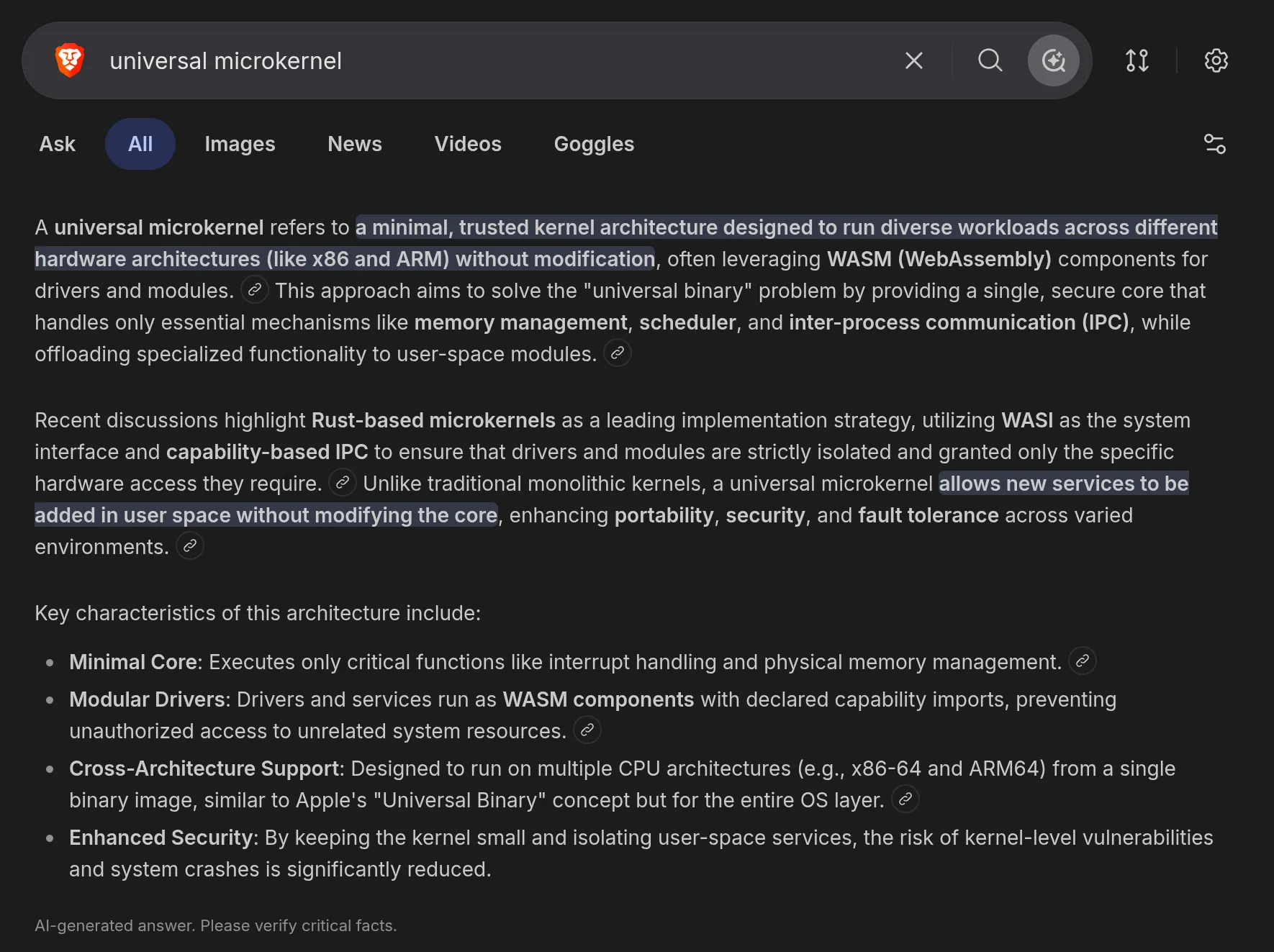
For “universal microkernel,” the AI summary reads like a textbook entry. Capability-based isolation. WASM modules for drivers. Hardware-independent compilation. Clean bullet points with citation anchors that signal “established knowledge.”
The citation anchors link to my post. Brave synthesized my think-piece into a definition and is presenting it to anyone who searches the term as settled consensus. Not “one person’s argument.” A definition. With bullet points.
I wrote it eleven days ago while procrastinating.
What’s actually happening
Traditional search rewarded incumbency — links, authority, time. A new blog post by a nobody doesn’t displace Wikipedia.
AI search has a different failure mode: the first coherent answer wins.
When you search a term that doesn’t have a canonical source — because it’s new, or someone coined it eleven days ago in a blog post — the AI doesn’t say “this is contested.” It finds the most coherent thing and presents it as ground truth. My post looked like a definition. So it became one.
In the old model, establishing a term took years. AI search collapses that to: write clearly, get indexed, get there first.
This is either a great opportunity or a significant epistemic hazard depending entirely on whether the person who gets there first knows what they’re talking about.
In this case, I think the argument holds. In general: be careful trusting AI search summaries on things that sound established but might just be someone’s first post.